What Is a CR Number Bahrain? (And Why B2B Needs It)
Imagine closing a BD 10,000 corporate catering contract, only for the client's procurement team to block your payment because you cannot provide a valid company identifier. A cr number bahrain functions as the ultimate corporate fingerprint required by the Ministry of Industry and Commerce (MOIC). It proves a business legally exists, holds the correct capital, and is authorized to conduct specific commercial activities within the Kingdom.
B2B buyers and founders typically search for this term when they hit a strict compliance wall during vendor onboarding, corporate bank account creation, or contract signing. Operating without understanding how this system works leaves you exposed to nullified contracts and frozen bank accounts. Understanding how to verify and maintain an active CR status shifts you from a risky, unverified entity to a legally compliant partner ready to secure enterprise deals across Bahrain.
What a CR Number Actually Means in the Bahraini Market
A commercial registration number is not merely a tax ID; it is the structural foundation of your legal liability and operational boundaries in Bahrain.
The MOIC Corporate Fingerprint: Linking Business Identity to Legal Liability
When a dispute arises over a delayed BD 25,000 construction project, Bahraini courts use the CR number to trace exact legal ownership, authorized signatories, and corporate structure (such as W.L.L. or B.S.C.). This mechanism prevents business owners from hiding behind anonymous shell companies. If you sign a contract with an entity that does not possess a valid CR, you are functionally signing an agreement with a ghost. You forfeit your ability to enforce non-compete clauses, recover stolen intellectual property, or sue for breach of contract in local courts because the counterparty does not legally exist in the commercial registry.
Active vs. Inactive Status Distinctions on the Sijilat Portal
Procurement managers must constantly monitor the status of their vendors, because a CR number can change states overnight. An "Active" status means the company has paid its annual MOIC fees, renewed its commercial municipal permits, and possesses valid licenses from sector-specific regulators (like the CBB for finance or NHRA for healthcare). If a vendor's status drops to "Deleted by Law" or "Inactive," any invoices they issue become legally invalid. Paying an inactive vendor creates an immediate audit vulnerability for your own company, as the National Bureau of Revenue (NBR) will likely reject VAT input claims associated with an unregistered entity.

ISIC Codes: How Your CR Strictly Dictates Allowed Revenue Streams
What people underestimate is that a CR number strictly fences in how a company can make money. Bahrain uses the International Standard Industrial Classification (ISIC Rev.4) system to categorize business activities. If your CR is registered for "Management Consultancy" (ISIC 7020), you cannot legally import and sell server hardware (ISIC 4651). When a vendor submits an invoice for an activity not listed under their specific CR branches, enterprise procurement teams will reject the payment. Adding multiple ISIC codes to a single CR allows for broader revenue streams, but this tradeoff often triggers higher minimum capital requirements and mandates approvals from additional government ministries.
How the Sijilat Registration and Verification Process Works
The Sijilat system is the central nervous system of Bahrain's commercial sector. Understanding its mechanics dictates how quickly you can onboard vendors or launch operations.
Navigating the Sijilat 3.0 Portal for Public Vendor Verification
In practice, relying on a PDF copy of a vendor's CR certificate is a massive operational risk, as the document could have been revoked the day after it was printed. Smart procurement teams mandate live verification through the public search function on the Sijilat 3.0 portal. By entering the cr number bahrain, you instantly surface real-time data: the exact date of expiration, the names of authorized signatories, and any active violations. If the person signing your Master Services Agreement is not explicitly listed as an authorized signatory on Sijilat, the contract is entirely unenforceable.
The 3-Step Lifecycle: Pre-approval, Without License, and Fully Active
Founders frequently misunderstand the timeline of commercial registration, assuming they can start trading immediately upon paying the initial fee. The mechanism operates in three distinct phases:
- Pre-approval: MOIC reserves your company name and approves the initial structure. You cannot sign leases or hire staff.
- Without License (CRWL): You receive a CR number, but you cannot legally operate or generate revenue. This status only exists so you can sign a commercial lease (address requirement) and open a preliminary bank account to deposit your share capital.
- Active: All municipal and sector-specific approvals are cleared. Only at this stage can you issue legally binding invoices and execute B2B contracts.
Connecting the CR to LMRA Permits and NBR VAT Certificates
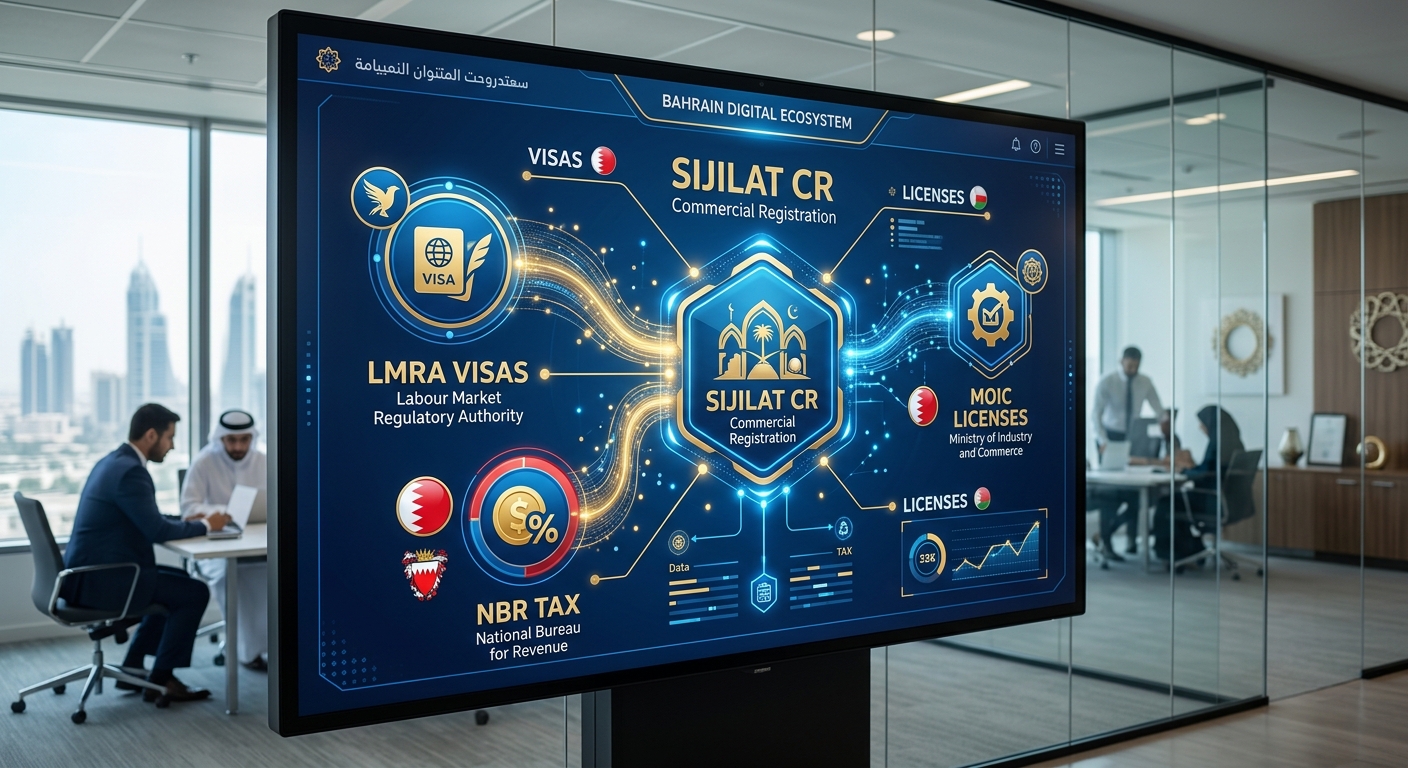
Your CR number acts as the master key that unlocks all other government integrations. The Labour Market Regulatory Authority (LMRA) pulls your CR data directly from Sijilat to determine your Bahrainization quota—the ratio of Bahraini to expat employees you must maintain. If your CR expires, your LMRA portal freezes instantly, blocking you from renewing expat work visas or applying for new ones. Similarly, the NBR requires an active CR to issue a VAT certificate. Operating with a disconnected or expired CR creates a cascading failure across every regulatory touchpoint in the Kingdom.
Common Misconceptions About Holding a Bahraini CR
False assumptions about commercial registration routinely cost businesses thousands of dinars in delayed operations and regulatory fines.
The 'One CR Fits All Activities' Fallacy
A common surprise for new market entrants is discovering that a single "General Trading" CR does not cover specialized services. You cannot use a retail clothing CR to bid on a government IT infrastructure project. Each distinct business line requires a specific ISIC code, and often, a separate branch under the main CR (e.g., CR No. 12345-1 and 12345-2). Attempting to funnel all operations through an mismatched activity code will eventually trigger an MOIC inspection, resulting in immediate financial penalties and a forced suspension of the unapproved activities.
Assuming a 'CR Without License' Allows for Contract Signing
Many startups make the fatal error of signing client contracts while holding a "CR Without License" status, assuming they will secure the final approvals before the invoice is due. This fails when the final municipal approval is denied due to zoning restrictions—for example, trying to open a commercial kitchen in a purely residential block in Saar. The business is left with signed client obligations they cannot legally fulfill, exposing the founders to personal liability for breach of contract because the corporate shield was never fully activated.
Confusing the CR Number with the VAT Account Number (TRN)
Accounts payable departments routinely reject invoices because vendors confuse their CR number with their Tax Registration Number (TRN). While the CR proves you exist, the 15-digit TRN proves you are authorized by the NBR to collect the 10% VAT. If a vendor puts their CR number in the TRN field on a tax invoice, the buyer cannot legally claim that 10% back as input VAT. This mistake directly damages the buyer's profit margins, leading them to freeze future orders until the vendor corrects their accounting software.
Why This Matters for B2B Contracts and Vendor Onboarding
In Bahrain's corporate ecosystem, your registration status dictates who will do business with you. Non-compliance is not just a legal issue; it is a revenue blocker.
Procurement Roadblocks: Why Enterprises Reject Unregistered Local Vendors
Large enterprises like Bapco, Alba, or Batelco utilize automated vendor management systems that ping the Sijilat database. If your cr number bahrain returns an error, or if your registered activities do not match the RFP category, the system automatically drops your bid. These enterprises cannot risk the compliance fallout of paying an unregistered entity, as it violates their internal anti-money laundering (AML) protocols and external audit requirements. You give up access to the entire enterprise market if your Sijilat profile is not perfectly maintained.
Enforcing Legal Recourse and Dispute Resolution in Bahraini Courts
When a vendor fails to deliver BD 8,000 worth of office furniture, your first step in legal recovery requires filing a claim against their CR. If you failed to verify their active status before paying the deposit, the courts will likely dismiss your commercial claim. You are then forced to pursue a much harder personal civil case against the individuals involved, assuming you can locate them. The CR system is designed to protect buyers, but it only works if you verify the data before money changes hands.
Unlocking Corporate Accounts with BBK, NBB, or Ila Bank
Local banks operate under strict Central Bank of Bahrain (CBB) mandates for Know Your Customer (KYC) compliance. You cannot open a corporate account at BBK, NBB, or Ila Bank without a fully active CR. Furthermore, if your CR expires while you have an active account, the bank's compliance software will flag the discrepancy and freeze outbound transfers within 30 to 60 days. This means you cannot run payroll, pay suppliers, or clear customs until the MOIC renewal fees are settled and the system updates.

Examples in Practice: The Operational Cost of CR Non-Compliance
Abstract rules translate into severe operational bottlenecks when ignored. Here is how CR failures manifest in daily business operations.
Scenario 1: Blocked Customs Clearance for BD 50,000 Tech Hardware Imports
A local IT managed services provider orders BD 50,000 in networking equipment from a distributor in Dubai. The shipment arrives at Khalifa Bin Salman Port, but Bahrain Customs blocks the release. The buyer's CR is registered strictly for "Software Development," which does not grant an import license for physical telecommunications hardware. The equipment incurs daily demurrage charges at the port while the company scrambles to apply for a new ISIC code through MOIC, a process that takes weeks and delays the entire client rollout.
Scenario 2: Immediate Rejection of LMRA Visa Applications for Expat Hires
A restaurant group plans to open a new branch in Adliya and attempts to apply for 15 new expat visas through the EMS portal. The LMRA system instantly rejects the applications. The HR manager discovers that the company's commercial municipality permit for one of their older branches expired two weeks prior, automatically shifting their master CR status to "Inactive." Until the municipality fee is paid and Sijilat reflects the active status, the entire company's hiring pipeline remains completely frozen.
Scenario 3: Nullified NDAs During Manama-Based Startup Acquisition Talks
A Manama-based fintech startup enters acquisition talks with a regional competitor. During the due diligence phase, the acquiring legal team discovers the startup's founders signed all Non-Disclosure Agreements (NDAs) using a CR number that was still in the "Pre-approval" phase. Because the corporate entity did not legally exist at the time of signing, the NDAs are deemed invalid. The acquirer realizes they have no legal obligation to protect the startup's proprietary algorithms, drastically reducing the startup's valuation and negotiating leverage.
Conclusion
The vital realization is that a cr number bahrain functions as the foundational trust mechanism for all B2B commerce, not merely a bureaucratic hurdle. Before signing any commercial lease or paying a BD 5,000 vendor invoice, you must verify the partner's CR status live on Sijilat to ensure they hold an "Active" status for the exact service they are selling. Next, review your own business model to ensure your planned activities align perfectly with the required MOIC ISIC codes. By treating your commercial registration as a strategic asset rather than a filing chore, you pave the way for seamless LMRA hiring, NBR tax compliance, and frictionless enterprise onboarding.